
Components of DOT Security’s Services
Explore each of the core elements that combine to form DOT Security’s complete offering
See how it all comes together
DOT Security’s holistic service- A plan to get back up and running if a problem occurs
- Comply with data security laws and industry regulations
- Expert planning and training to improve overall security
- Protection for a controlled internal environment
- Coverage for individual systems and devices
- Control who can get into your networks
- Improved insight into data and communications
- Extra fortification for your most sensitive data
Risk Assessment
InsightsCybersecurity insights and analyses
Dive into the world of modern cybersecurity with explanations, predictions, and expert opinions
Find blogs, infographics, videos, and more
DOT Security insights- Definitions for industry terms and acronyms
- The complete beginner’s guide to everything cybersecurity
Backup And Disaster Recovery
What Is Cyber Warfare?
July 10, 2024
9 minute read

If you saw the movie Leave the World Behind, you might already have an idea of how cyber warfare would play out in reality. While the 2023 film is fully fictionalized, the gravity of cyber warfare and the devastation it could bring about is a very serious concern. As technology continues advancing, cyberattacks have become extremely sophisticated and could play a major role in future wars.
While businesses operating solely in the private sector may not feel like they would have a role to play in a wartime scenario, being aware of these possibilities and taking measures to protect yourself, your business, and your people showcases your dedication to security and data privacy.
Sign up for our newsletter!
Continue reading to learn more about the effects of cyber warfare, popular tactics and techniques, and the role of a comprehensive cybersecurity strategy that includes a powerful backup and disaster recovery plan.
If you’d like help building and installing a comprehensive cybersecurity strategy that covers all your network’s nooks and crannies, get started with an expert from DOT Security today.
Defining Cyber Warfare
Cyber warfare refers to the use of digital attacks by one nation-state against another to achieve strategic objectives. Unlike traditional warfare, which involves physical confrontations on land, sea, or air, cyber warfare occurs in the digital realm, leveraging the interconnected networks and systems that underpin modern society.
This form of warfare targets a country's information infrastructure, aiming to disrupt, damage, or gain unauthorized access to critical systems.
The motivations behind cyber warfare are varied and complex. They can range from political and military objectives to economic and psychological impacts. Nation-states may engage in cyber warfare to undermine the operational capabilities of an adversary, steal sensitive information, influence public opinion, or destabilize critical infrastructures.
The stealthy and anonymous nature of cyber operations allows attackers to strike without immediate detection, complicating the defense and response efforts of the targeted nation.
In the context of international relations, cyber warfare introduces new challenges and dynamics. The lack of physical boundaries in cyberspace means that attacks can be launched from anywhere in the world, often obscuring the true identity of the perpetrators. This ambiguity can escalate tensions between nations and complicate diplomatic efforts.
Additionally, the legal and ethical frameworks governing cyber warfare are still evolving, creating uncertainties around issues of attribution, proportionality, and retaliation.
As societies become more dependent on interconnected technologies, the potential for disruption through cyber means increases. Understanding cyber warfare's fundamental nature and implications is crucial for developing effective strategies to defend against and mitigate its impact.
Types of Cyber Warfare
Just as there are a variety of different fronts over which a physical war can be carried out, cyber warfare is a general umbrella term that includes a number of powerful but disruptive tactics and techniques that can wreak absolute havoc on an unprepared nation.
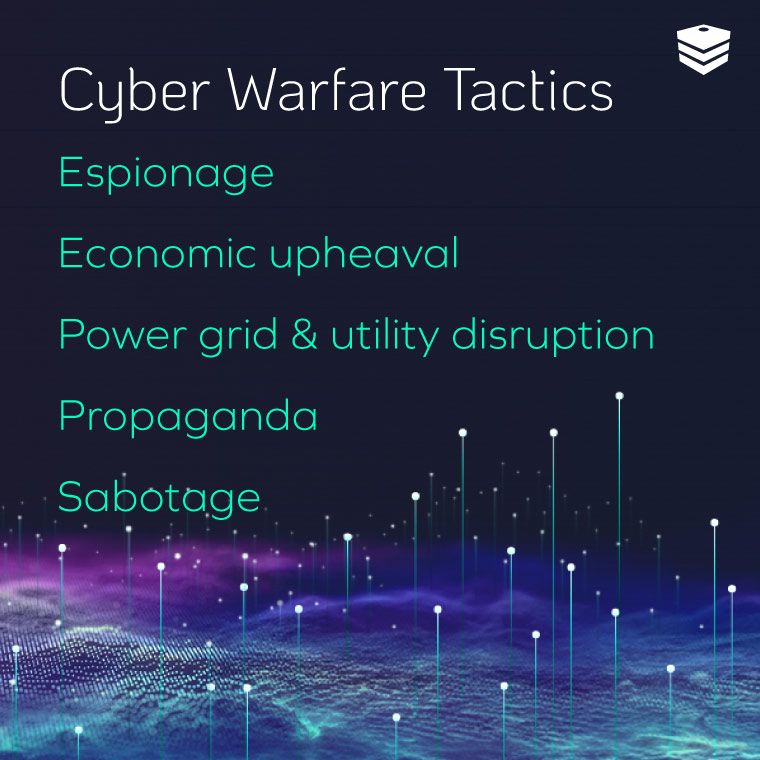
Five of the major cyber warfare tactics are detailed below and include:
- Espionage
- Economic upheaval
- Power grid and utility disruption
- Propaganda
- Sabotage
1. Espionage
Cyber espionage is the covert acquisition of confidential information from government, corporate, or personal systems by nation-states or other actors. This form of cyber warfare aims to gather intelligence on political strategies, military plans, technological innovations, or economic data.
By infiltrating secure networks, attackers can steal sensitive information without the knowledge of the targeted entity. The stolen data can then be used to gain a competitive advantage, influence decision-making processes, or prepare for further cyber or traditional military operations.
The stealthy nature of cyber espionage makes it a preferred tool for intelligence agencies, as it allows them to operate under the radar and avoid direct confrontation.
2. Economic Upheaval
Economic upheaval in the context of cyber warfare involves disrupting a nation's economic stability through targeted digital attacks. These attacks can include the theft of financial assets, manipulation of stock markets, disruption of banking operations, or compromising supply chains.
The goal is to weaken the economic foundations of a country, creating financial instability and eroding public confidence in the government and institutions. Such actions can have long-lasting effects, hindering economic growth and potentially leading to widespread economic distress.
By destabilizing a nation's economy, attackers can exert pressure on political leaders and influence national policies.
3. Power Grid and Utility Disruption
Attacks on power grids and utilities represent a critical threat in cyber warfare, aiming to disrupt essential services that a nation relies on. Cyberattacks targeting these infrastructures can result in widespread power outages, water supply disruptions, and the incapacitation of other critical services.
Such disruptions not only cause immediate chaos and inconvenience but also pose severe risks to public safety and national security. In the long term, these attacks can damage infrastructure, leading to costly repairs and prolonged service interruptions.
By crippling vital utilities, attackers can weaken a nation's resilience and response capabilities, amplifying the overall impact of their assault.
4. Propaganda
Cyber warfare also employs propaganda to manipulate public perception and influence political outcomes. Through social media, fake news websites, and other online platforms, attackers disseminate false or misleading information to shape public opinion, create social discord, or undermine trust in institutions.
This digital propaganda can sway elections, incite violence, and polarize communities. By controlling the narrative, attackers can destabilize a nation from within, weakening its social fabric and democratic processes. The rapid spread of information online makes it difficult to counteract these campaigns, amplifying their efficacy and reach.
5. Sabotage
Sabotage in cyber warfare involves deliberately damaging or destroying an adversary's digital or physical assets to impair their operational capabilities. This can include attacks on industrial control systems, military equipment, communication networks, and other critical infrastructures.
By introducing malware, disrupting systems, or corrupting data, attackers can halt production processes, disable defense mechanisms, and create significant logistical challenges. The goal of sabotage is to weaken the adversary's ability to function effectively, whether in a military, economic, or societal context.
The covert nature of cyber sabotage allows attackers to execute these operations without immediate detection, often leaving the targeted entity scrambling to identify and mitigate the damage.
Including Cyber Warfare in Backup and Disaster Recovery Plans
To safeguard against cyber warfare, organizations must integrate specific strategies into their backup and disaster recovery (BDR) plans. This involves identifying critical assets and data likely to be targeted by cyberattacks and ensuring they are regularly backed up to secure, isolated locations.
By maintaining offsite and cloud-based backups, organizations can quickly restore operations if primary systems are compromised. Advanced encryption and multi-factor authentication for backup systems are essential to protect against unauthorized access and tampering.
A comprehensive BDR plan must also include regular testing and updating of backup and recovery procedures. Routine drills and simulations of various cyberattack scenarios help identify vulnerabilities and improve response times. Training employees and establishing clear protocols ensures everyone knows their role during a cyberattack, minimizing downtime and data loss for a swift recovery.
Incorporating cyber warfare considerations into BDR plans enhances an organization's resilience to cyber threats, ensuring critical operations can continue with minimal disruption even during sophisticated attacks. This continuity is crucial for maintaining customer trust and preventing financial losses associated with prolonged outages.
A well-prepared BDR plan that accounts for cyber warfare reduces the overall impact of an attack. Pre-established recovery protocols enable organizations to quickly identify and isolate affected systems, preventing the spread of malware and limiting damage.
Finally, including cyber warfare in BDR plans demonstrates a commitment to robust cybersecurity practices, enhancing an organization's reputation and credibility. Customers, partners, and stakeholders are more likely to trust organizations that prioritize cybersecurity and have clear strategies for dealing with cyber threats.
This trust can translate into competitive advantages, as businesses and consumers increasingly prioritize cybersecurity in their decision-making.
Making Comprehensive Cybersecurity a Priority
The reality of cyber warfare makes it imperative for businesses to prioritize comprehensive cybersecurity due to the elevated threat landscape that includes sophisticated, state-sponsored attacks.
Comprehensive cybersecurity enables businesses to build strong defenses against advanced threats through a multi-layered security approach, including firewalls, intrusion detection systems, encryption, and regular security audits. This proactive stance helps detect and respond to threats, minimizing breach risks and ensuring data integrity.
The interconnected nature of modern business operations means that a successful cyberattack can disrupt entire supply chains. Prioritizing cybersecurity protects not only the targeted company but also its partners, suppliers, and customers. Ensuring high-security standards across all connected entities reduces the risk of widespread disruption.
Investing in comprehensive cybersecurity offers significant reputational benefits, as customers and partners increasingly trust businesses committed to strong security practices. This trust can lead to increased loyalty, better business relationships, and a competitive edge.
Final Thoughts on Cyber Warfare
It never helps to doom spiral, but it is extremely important for business leaders, decision-makers, and heads of industry to recognize and understand the reality of disaster scenarios. Just like it’s considered a best practice to create a backup and recovery plan in the face of a natural disaster, it’s critical to have a plan of action installed in the event of cyber warfare.
As technology continues to rapidly evolve right in front of our eyes, cyberattacks are evolving just as fast, which only makes it more imperative that organizations prioritize the development and installation of a modern and comprehensive cybersecurity strategy.
Don’t delay the installation of a modern cybersecurity strategy any further and get started with an expert from DOT Security today who can help you build a series of custom solutions just for your business.